Khushi
Jain
Product, Design, '23 – now
Khushi
Jain
Product, Design, '23 – now

Timeline
Jan - Dec 2023
Team
Solo
My Role
Product Design, Design Research, Illustrations, Conversational Design
When therapy doesn’t align with a person’s unique needs, it can feel like starting over—again and again.
When therapy doesn’t align with a person’s unique needs, it can feel like starting over—again and again.
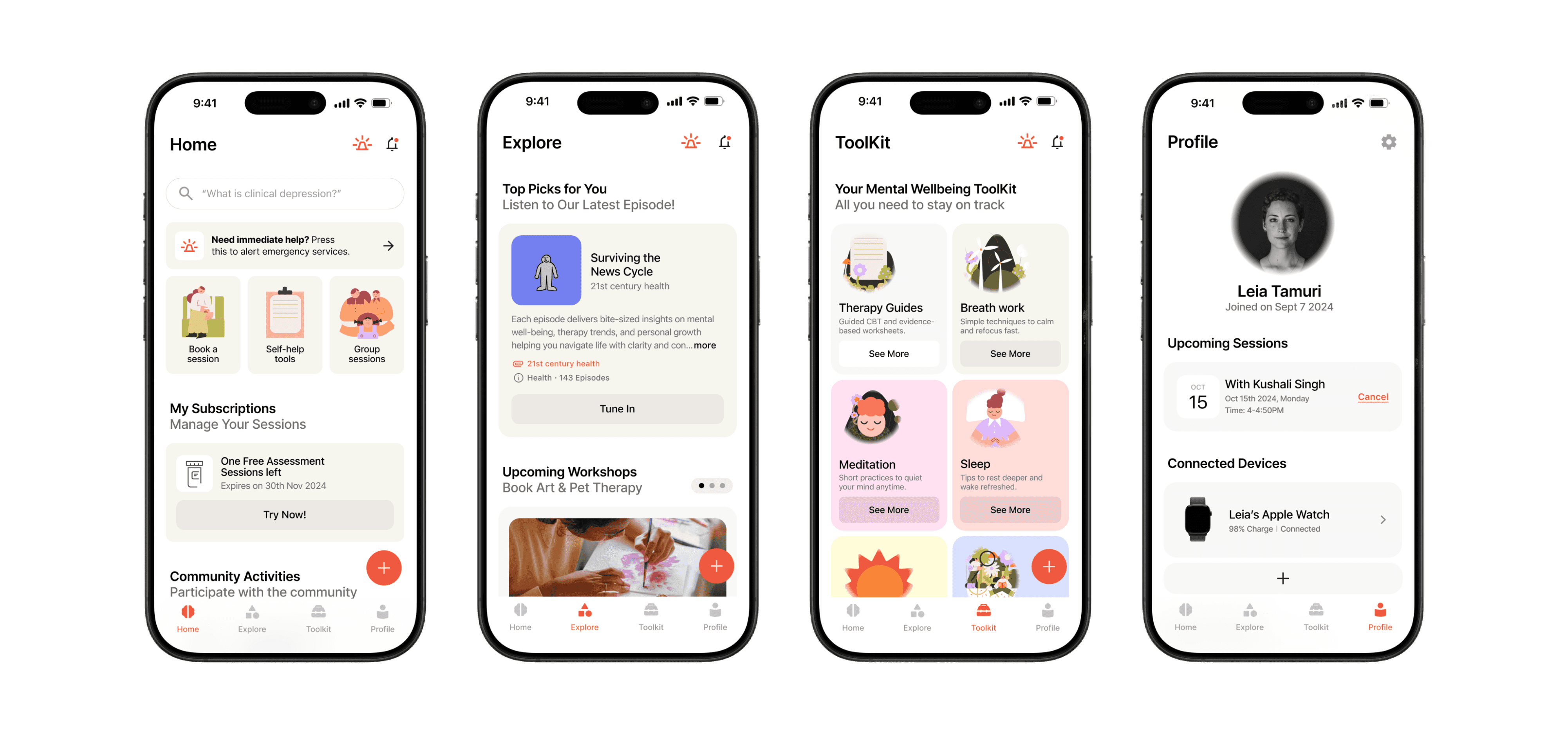
I designed Nurture, a mental health support ecosystem that helps people find compatible therapists, access support between sessions, and build meaningful connections through peer communities. The work brought together therapist matching, conversational support, and community care into a single experience designed to improve continuity throughout the mental health journey.
I designed Nurture, a mental health support ecosystem that helps people find compatible therapists, access support between sessions, and build meaningful connections through peer communities. The work brought together therapist matching, conversational support, and community care into a single experience designed to improve continuity throughout the mental health journey.
Recognition
Published in Springer
Presented at Cambridge
NPS points
~18%
of participants were more likely to recommend the experience after interacting with the prototype.
adoption intent
~87%
of testing participants indicated they would consider using at least one feature within the ecosystem.
concept desirability score
~82%
of participants rated the proposed solution as valuable and relevant to their mental health needs.


INitial observations
Therapy support often ends when the session ends.
Therapy support often ends when the session ends.
Many mental health platforms focus on helping users book appointments or access therapists, but the broader support journey is often fragmented.
Many mental health platforms focus on helping users book appointments or access therapists, but the broader support journey is often fragmented.


People struggle to find therapists they connect with, receive little opportunity to provide meaningful feedback, discontinue therapy because of financial barriers, and often enter treatment without fully understanding what to expect.
People struggle to find therapists they connect with, receive little opportunity to provide meaningful feedback, discontinue therapy because of financial barriers, and often enter treatment without fully understanding what to expect.
The result is a cycle of uncertainty, frustration, and repeated restarts.
The result is a cycle of uncertainty, frustration, and repeated restarts.
The result is a cycle of uncertainty, frustration, and repeated restarts.
The result is a cycle of uncertainty, frustration, and repeated restarts.
To better understand these challenges, I conducted a mixed-method research study involving 88 survey participants and 45 in-depth interviews.
To better understand these challenges, I conducted a mixed-method research study involving 88 survey participants and 45 in-depth interviews.
RESEARCH
Understanding the therapy experience from multiple perspectives
Understanding the therapy experience from multiple perspectives
To identify gaps in existing mental health care experiences, I combined:
To identify gaps in existing mental health care experiences, I combined:
1
1
Observational studies
Observational studies
2
2
Market analysis
Market analysis
3
3
Literature review
Literature review
4
4
Surveys (88 participants)
Surveys (88 participants)
5
5
Open-ended interviews (45 participants)
Open-ended interviews (45 participants)
The findings were synthesized through personas, journey maps, and experience frameworks to uncover recurring barriers throughout the therapy journey.
The findings were synthesized through personas, journey maps, and experience frameworks to uncover recurring barriers throughout the therapy journey.
Incompatibility
One of the most common challenges participants described was incompatibility. Many people struggled to identify therapists who matched their communication style, needs, preferences, or expectations.
Lack of Patient Feedback
Whether discussing treatment approaches, communication preferences, or concerns about progress, many felt their input was not acknowledged in meaningful ways.
Financial Constraints
Cost concerns frequently forced people to reduce session frequency or stop treatment entirely, creating interruptions during critical periods of support.
Lack of Informed Consent
Participants wished they had clearer expectations regarding treatment approaches, timelines, communication styles, privacy, and what progress might realistically look like.
Opportunity
Could support happen before, between, and beyond therapy sessions?
Could support happen before, between, and beyond therapy sessions?
The research revealed opportunities to improve continuity across the entire mental health journey rather than focusing solely on appointments.
The research revealed opportunities to improve continuity across the entire mental health journey rather than focusing solely on appointments.
This led to four initial product directions:
This led to four initial product directions:
1
1
Better therapist matching
Better therapist matching
2
2
Personalized emotional support
Personalized emotional support
3
3
Ongoing community-based care
Ongoing community-based care
4
4
Greater transparency throughout the therapy journey
Greater transparency throughout the therapy journey

How Might We
Support patients before, between, and beyond therapy sessions?
How Might We
Support patients before, between, and beyond therapy sessions?
How Might We
Support patients before, between, and beyond therapy sessions?
Discovery
Mapping Use Cases and Information Architecture
Mapping Use Cases and Information Architecture
Drawing from over 5 mental health platforms, I outlined the main use cases and built the app’s information architecture.
Reviewed with stakeholders, refined based on feedback.
Drawing from over 5 mental health platforms, I outlined the main use cases and built the app’s information architecture.
Reviewed with stakeholders, refined based on feedback.


Created user flows to map out key journeys, then sketched low-fidelity wireframes.
Presented for feedback again, adjusted flows and layouts
Created user flows to map out key journeys, then sketched low-fidelity wireframes.
Presented for feedback again, adjusted flows and layouts


Final delivery
The final concept was evaluated through iterative prototype testing.
The final concept was evaluated through iterative prototype testing.
Participants interacted with key workflows across therapist matching, conversational support, and community experiences.
Participants interacted with key workflows across therapist matching, conversational support, and community experiences.
Outcomes:
Outcomes:
1
84% reported increased confidence when selecting a therapist
84% reported increased confidence when selecting a therapist
2
+18 NPS improvement
+18 NPS improvement
3
79% stated they would use support features between therapy sessions
79% stated they would use support features between therapy sessions
4
86% found community support features valuable
86% found community support features valuable
What Didn't Work
What Didn’t Work
The first version tried to solve too much at once
The first version tried to solve too much at once
Early concepts combined therapist matching, emotional support, education, and community features into a single experience. While comprehensive, testing revealed that users felt overwhelmed by the number of options presented upfront.
Early concepts combined therapist matching, emotional support, education, and community features into a single experience. While comprehensive, testing revealed that users felt overwhelmed by the number of options presented upfront.
The conversational coach was initially misunderstood for helpline. So I had to integrate it meaningfully into the user’s flow instead of having it as a stand alone feature.
The conversational coach was initially misunderstood for helpline. So I had to integrate it meaningfully into the user’s flow instead of having it as a stand alone feature.
During testing, several participants initially interpreted the conversational coach as a customer service feature rather than a tool for emotional support. Because it existed as a standalone feature, users lacked the context needed to understand how it fit into their therapy journey.
During testing, several participants initially interpreted the conversational coach as a customer service feature rather than a tool for emotional support. Because it existed as a standalone feature, users lacked the context needed to understand how it fit into their therapy journey.


Lessons Learned
What I’d do differently
What I’d do differently
Do it right or do it Twice
Do it right or do it Twice
Version 1 taught me that cutting corners early means double the work later.
Version 1 taught me that cutting corners early means double the work later.
Details are time consuming
Details are time consuming
The details will often take a long time, think about the 80/20 rule. It is best to design for the whole story first and worry about the details later.
The details will often take a long time, think about the 80/20 rule. It is best to design for the whole story first and worry about the details later.
Contact
Ways to reach out
For information, images, and media resources.
For fun projects (coming soon), & images.
To know more about my experience.
Contact
Ways to reach out
For information, images, and media resources.
For fun projects (coming soon), & images.
To know more about my experience.
Contact
Ways to reach out
For information, images, and media resources.
For fun projects (coming soon), & images.
To know more about my experience.